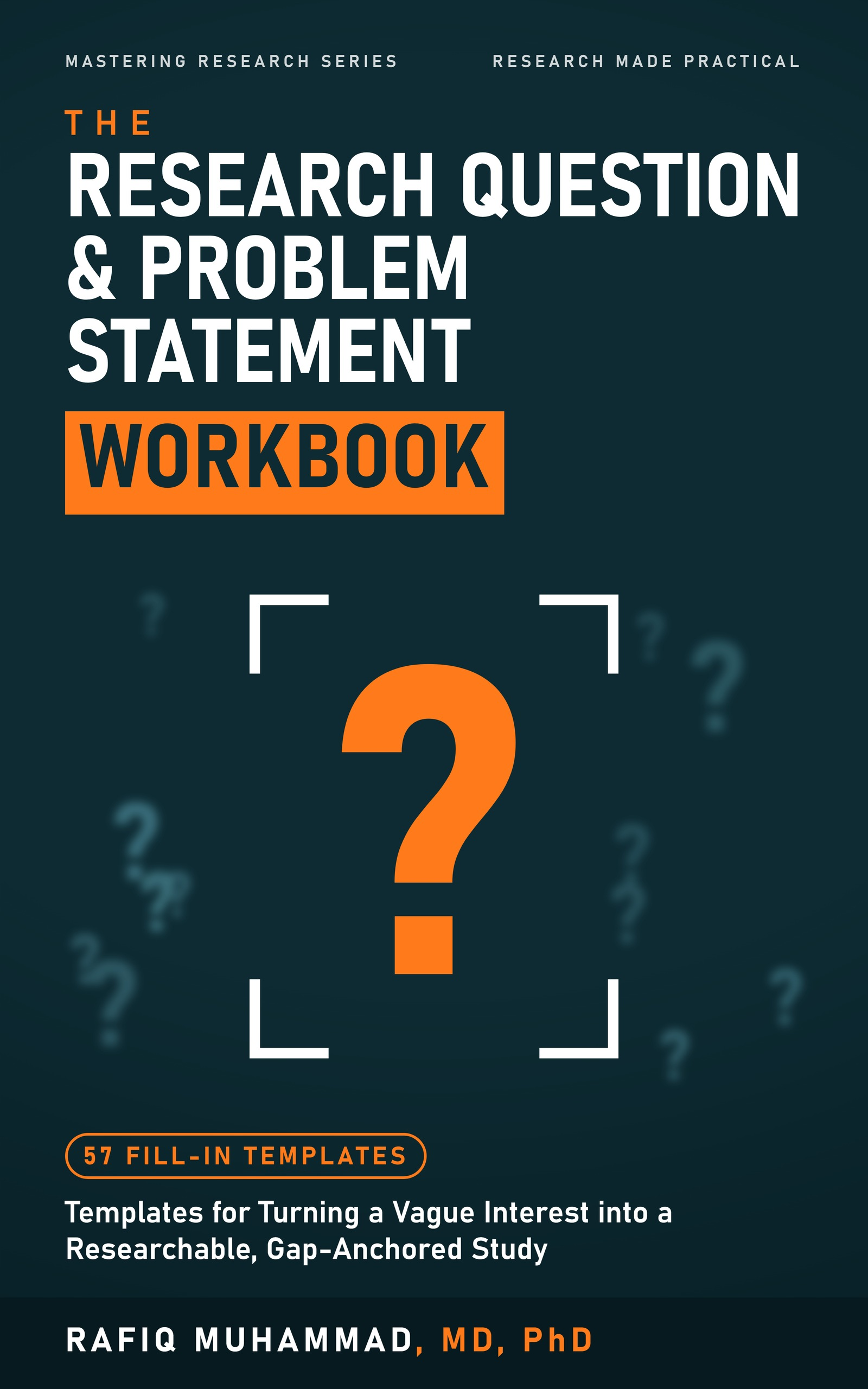
The Research Question and Problem Statement Workbook
Research Made Practical Series

The Research Question & Problem Statement Workbook

57 Templates for Turning a Vague Interest into a Researchable, Gap-Anchored Study

You have a topic you care about. You do not yet have a study. Almost every graduate student hits the same wall: an interest such as online learning or burnout, and no clear way to turn it into a focused question, a problem statement, and a design that hold together. That distance is where months disappear and where early proposals stall.

The Research Question & Problem Statement Workbook is not another textbook about research. It is a working surface: 57 fill-in templates across eleven chapters, each one a single decision on a single page. One fictional study is worked from a vague interest to an aligned design beside the blank templates, so you can see each step done before you do your own.

Who this workbook is for: Master's and doctoral students choosing and shaping a thesis topic, professional-doctorate candidates (EdD, DNP, DBA) preparing a proposal, early-career researchers planning a first independent study, and supervisors who want a structured process to hand to their students.
What's Inside

✓

Topic Funnel & Documented Literature Scan

A five-level funnel that narrows a broad interest to one workable angle, and a quick, documented scan that finds the conversation you are joining.

✓

Problem, Purpose & Question Builders

A problem statement in five moves with evidence behind every claim, purpose statements for quantitative, qualitative and mixed-methods studies, and research questions screened for quality.

✓

The Alignment Matrix

One matrix tying problem, purpose, questions, hypotheses, variables and analysis together, so the golden thread through your study is visible to a committee at a glance.

Core Checklists & Templates Included

  • 57 fill-in templates across eleven chapters, each a single decision on a single page, with a worked study beside the blanks
  • FINER, PICO, PEO and SPIDER frameworks, with feasibility, scope and ethics checks
  • Null and alternative hypotheses, or a documented confirmation that your study needs none
  • Conceptual and operational definitions for every variable: what it means and how you will measure it
  • A one-page study summary, a thirty-second pitch, and a rehearsal of the questions a committee will ask

Every template carries a supervisor sign-off line, and every chapter ends with the common mistakes and a checkpoint naming exactly what to bring to your advisor.

Companion kits for the series